
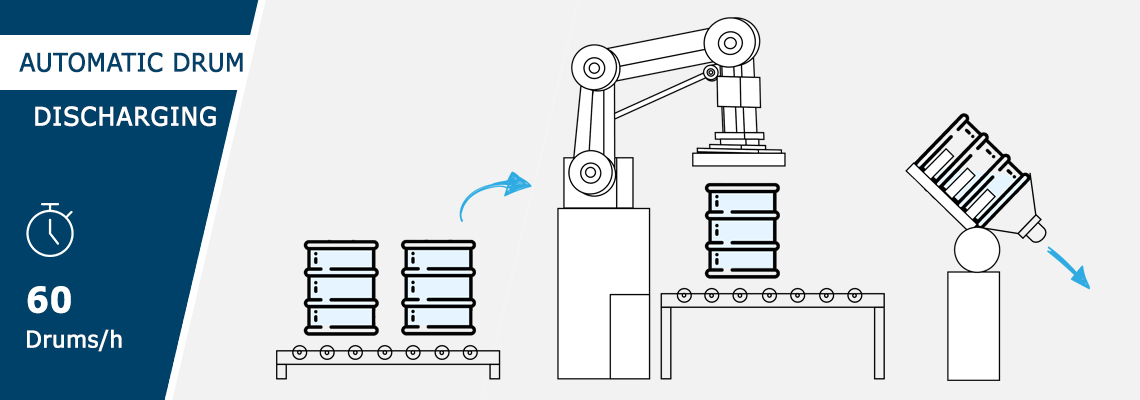
Palamatic Process can guarantee a turnkey solution for the automatic deconditioning of barrels, managed from order to commissioning by our teams of process specialists in automated lines.
MODELS
| DRUMMATIC® 01 | DRUMMATIC® 02 | DRUMMATIC® 03 | DRUMMATIC® 04 | |
|---|---|---|---|---|
| Drum dimension | Diam – 390 – 650 mm Height : 570 – 970 300 Kg / drum max |
|||
| Sealing | No | No | Yes | Yes |
| Capacity | 30 drums/h | 60 drums/h | 15 drums/h | 30 drums/h |
| Drum emptying type | Total | Total | Dosing after emptying | Total |
| Turner table | DrumFlow® 03 | DrumFlow® 03 | DrumFlow® 04 | DrumFlow® 04 |
PREPARATION OF DRUMS FOR AUTOMATIC LOADING
Pallets of full drums are stored by accumulation on roller conveyors. The driver places the drums of product on an anti-static conveyor, where the straps and plastic films surrounding the drums are removed.
The drums are then transferred to the drum opening station where the operator removes the lids and opens the inner bag, when applicable. In order to optimize the operator ergonomics, a turntable is integrated to allow easy access and handling of the drums. Following validation with a two-handed safety system, the pallet of drums is loaded and the rest of the process takes place in full automation.
► Does the installation completely empty the barrels automatically?
Yes. The operator still needs to:
- Load the pallets of drums onto the conveyors
- Scan the drum reference (optional)
- Remove lids and desiccant bags
The rest of the process is automated.
DEPALETTIZATION OF DRUMS BY ROBOT
The pallet advances to the robot depalletizing station. A 5-axis palletizing robot analyzes the loading of the pallet using its optical sensor. Handling of the barrel is conducted by a sturdy gripper which places the full drum on the deconditioning station. The special gripper developed by Palamatic Process makes it possible to guarantee the correct handling of the barrel during the transfer phase. This self-tightening device ensures continuous line availability.
These phases of palletizing and depalletizing the drums are programmed in order to optimize line throughput.
► Which drums are compatible with handling by an articulated robot?
Metal and stainless steel drums with their rounded edges are ideal for handling by the gripper. When handling plastic drums, special attention must be paid to the deformation of the drums. A rim must be present on the drum to automate its deconditioning. Cardboard drums, if they are not equipped with rims, must be taken into special consideration to define which mechanical or pneumatic gripper to choose.
AUTOMATIC DRUM UNLOADING
The drum is automatically placed on the DrumFlow® 04 unloading station. A conveyor wedges the drum in the turn table. A cone covers the barrel and where an internal inflating seal provide a dust tight connection. The holding rods descend into the barrel to prevent the internal bags from coming loose in the process.
The device then swivels and turns the barrel upside down. The cone is then docked in the receiving hopper while maintaining a dust tight seal where the material is then emptied and dosed. The 180 ° inversion allows a total emptying of the barrel’s contents. The system from start to stop is fully contained. A vacuum chamber can be added around the drum deconditioning system for the most toxic of products.



No comment